Rousseau on Education, Freedom, and Judgment by Denise Schaeffer
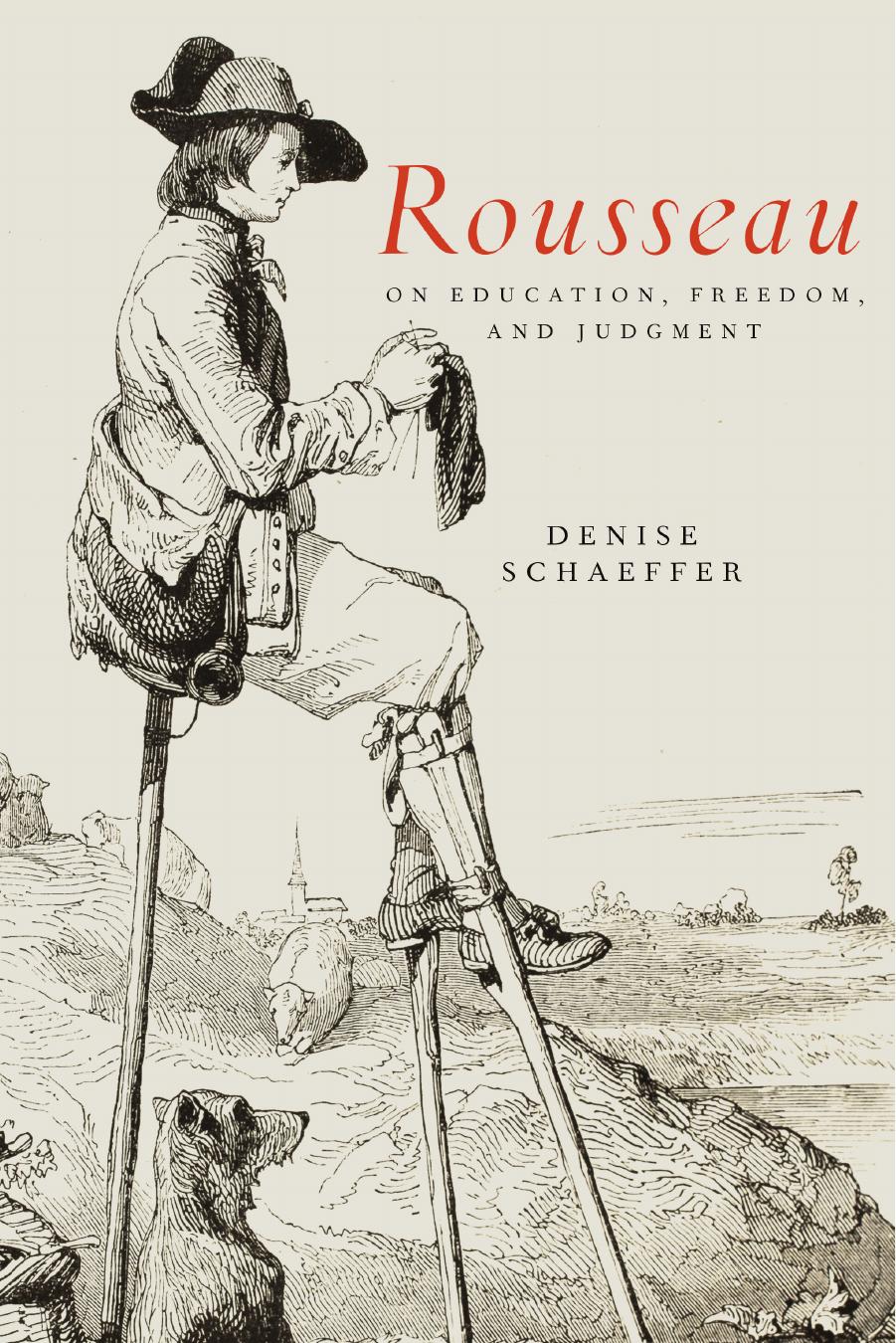
Author:Denise Schaeffer [Schaeffer, Denise]
Language: eng
Format: epub, pdf
Publisher: Penn State University Press
Published: 2014-01-01T23:00:00+00:00
6
JUDGMENT, LOVE, AND ILLUSION
Love has been presented as blind because it has better eyes than we do and sees relations we are not able to perceive. (E, 214; 4:494)
On the surface, Rousseau’s discussion of love in book V of Emile seems focused principally on the cultivation of virtue and has little to do with the cultivation of judgment. Rousseau’s earlier rhetoric about the importance of Emile’s thinking his own thoughts disappears, replaced by a concern with directing his pupil toward a healthy sociability and preventing sexual debauchery. “I shall make him moderate by making him fall in love” (327; 4:654). Emile falls in love with a woman named Sophie who exists as an idealized poetic construction in his imagination long before he meets her in person. The lure of this imaginary love object makes Emile moderate by making him “disgusted with those that could tempt him; it suffices that he everywhere find comparisons which make him prefer his chimera to the real objects that strike his eye” (329; 4:656). Thus one wonders whether he is exercising independent judgment or simply reacting on the basis of his conditioning, manipulated by his attachment to a salutary illusion.
One could argue that the image of an idealized beloved functions as a “compass,” guiding Emile’s judgment just as the standard of utility functioned earlier in his education. But there are significant differences that suggest that Emile is not simply trading one standard for another. In book III, Rousseau presents his pupil as capable of determining for himself the utility of this or that object. To be sure, the example of Robinson Crusoe shapes Emile’s understanding of utility, but Emile does not apply Crusoe’s standard uncritically. He is expected “to examine his hero’s conduct” and take note of his failings. “The surest means of raising oneself above prejudices and ordering one’s judgments about the relations of things is to put oneself in the place of an isolated man and to judge everything as this man ought to judge of it with respect to his own utility” (185; 4:455, emphasis added). Emile does not simply take Crusoe’s judgments for his own. Furthermore, as he moves from judging “the relations of things” to making judgments about people and social relations in book IV, Emile is similarly required to reflect on the images his tutor parades before his eyes.
When it comes to the idealized image of Sophie, however, it is less clear whether Emile ever achieves any measure of critical distance. First, we must notice that when Emile meets Sophie in person and hears her name for the first time, he does not even begin to judge for himself whether she is the Sophie of his dreams but simply looks to his tutor for confirmation. Furthermore, as their relationship progresses, Sophie manipulates Emile’s affections and rules him indirectly, in much the same way that his tutor did earlier. And while Rousseau insists that Emile preserve some modicum of his former independence by taking a break from Sophie in order
Download
Rousseau on Education, Freedom, and Judgment by Denise Schaeffer.pdf
This site does not store any files on its server. We only index and link to content provided by other sites. Please contact the content providers to delete copyright contents if any and email us, we'll remove relevant links or contents immediately.
| Anthropology | Archaeology |
| Philosophy | Politics & Government |
| Social Sciences | Sociology |
| Women's Studies |
The remains of the day by Kazuo Ishiguro(9086)
Tools of Titans by Timothy Ferriss(8493)
Giovanni's Room by James Baldwin(7436)
The Black Swan by Nassim Nicholas Taleb(7197)
Inner Engineering: A Yogi's Guide to Joy by Sadhguru(6836)
The Way of Zen by Alan W. Watts(6672)
The Power of Now: A Guide to Spiritual Enlightenment by Eckhart Tolle(5854)
Asking the Right Questions: A Guide to Critical Thinking by M. Neil Browne & Stuart M. Keeley(5832)
The Six Wives Of Henry VIII (WOMEN IN HISTORY) by Fraser Antonia(5558)
Astrophysics for People in a Hurry by Neil DeGrasse Tyson(5224)
Housekeeping by Marilynne Robinson(4504)
Double Down (Diary of a Wimpy Kid Book 11) by Jeff Kinney(4335)
12 Rules for Life by Jordan B. Peterson(4331)
Ikigai by Héctor García & Francesc Miralles(4311)
The Ethical Slut by Janet W. Hardy(4308)
Skin in the Game by Nassim Nicholas Taleb(4306)
The Art of Happiness by The Dalai Lama(4169)
Skin in the Game: Hidden Asymmetries in Daily Life by Nassim Nicholas Taleb(4051)
Walking by Henry David Thoreau(4002)
